Showing posts with label Environment. Show all posts

Thursday, February 21, 2008

Trees, You and Life!!

Today, global warming is a major threat to human beings. The case of Borivali National Park is there for all of us to see; it is today under the growing threat from Human intrusion. Also, there is increasing cases of attacks by big cats on Humans. The issues are different, but the reason behind them are the same; Deforestation. To know what the main reasons behind deforestation are, the problems of it and it's possible solution, we met and interviewed a notable and respected of environmentalist, Dr. Ashok Kothari.

Interview of an Environmentalist: - Dr. Ashok S. Kothari M.B.B.S.

Dr. Ashok S. Kothari practices Medicine in his clinic named 'Tree Shade Clinic' in Santa Cruz.. He is the former President of Santacruz Medical Social Association and also the past president of the Rotary Club of Bombay Seacoast and currently he is the Chairman of the Souvenir Subcommittee. He also holds a post in a Bombay Natural History Society as a Hon. Joint Secretary (Since 1984), which plays a major part in conserving nature. He has provided his contribution to the National Society of the Friends of the trees, which specifically works for the preservation of trees and has won many awards for planting the largest amount of trees.

He has also provided his contribution in the field of environmental publications, working as a Co-Editor for Salim Ali's India -1996 and Treasures of Indian Wildlife -2005 (BNHS & OUP Publications). He is someone who has been actively involved in Nature conservation and has also won many awards for doing a stellar job in planting trees.

Interview…..

Q.1. What is the Status of the environment that we live in?

We are felling trees at an alarming rate because of the pressure from growing population; as a result all the forests have been rendered very thin. The forest that we once had is just a fraction of the size it once was, and it continues to decrease every day. Even The Borivali National Park is under the growing threat of Human intrusion. And it is therefore no coincidence that there is increasing attacks of big cats on Humans, that’s the threat we face when nature is taken for granted.

People don't seem to have realised the importance of the Forest cover for the ecology of Mumbai. Every tree in Mumbai needs to be protected and we cannot just ignore the threat it poses to the environment and thereby to all of us as well. Remember…"Compromising on Trees is compromising on Life".

Q.2. What are the major implications on our nature an account of deforestation?

There are many implications some of which are very dangerous for humans and also the nature as a whole. Firstly the sea level is increasing rapidity. The experts’ are stating that global warming is aided by the effects of deforestation. Also, our life will become dull; and as pollution increases there will be an acute shortage of water. And this fact is showcased by various examples from our nature; like the 'Sahara' which is increasing and expanding in size every year and deforestation is to blame say the experts . The positive's side of forest cover is aptly demonstrated by the contribution of a single man can have on the nature, which is demonstrated by the effects his love for trees had on the small district of 'Palanpur' in North Gujarat.

A tree lover' Khalid Ahmed Khan' has been planting trees every year and had been stopping trees from being felled and exploited. After some years, through the contribution of this one individual it was seen that the annual rainfall increased from 12 inch to 32 inch. In contrast in 'Cherapunji' the rainfall is decreasing owing to deforestation, this example highlights the effect that trees have on nature.

Apart from these problems there is also the problem of erosion, landslides and also conservation of wildlife and the water sources, which also has a lot to do with trees as all of them are interdependent and interconnected.

Trees play a vital role in maintaining the balance of nature. If one tree is cut in nature it also means that many other forms of life are threatened and are now left vulnerable. And one of the reason that Mumbai has a regular and sufficient amount of water supply is the fact that it is surrounded by lakes from where it gets it's water supply. And these lakes are surrounded by trees which guarantees steady rainfall. And if we start cutting down these trees the entire Mumbai will be left vulnerable.

Q.3. According to you, what are the factors that have contributed to the problems of deforestation?

The biggest factors leading to deforestation are that, earlier we used to worship trees, but today we view it just as a commodity, which is there just to make our life better, nothing else. Even the tribal, who were seen as a protector of trees are now exploiting them. A tree, which is essential for a tribes existence has now become a partner in exhausting them. In the tribal area, it is not hard to see truckloads of trees coming out with load full of trees chopped illegally. This clearly shows there is a growing nexus between the tribals and the Timber mafia. The mafias are now very powerful and they make use of the corrupt authorities and ill-informed locals to make money out of the trees. The mafias are exploiting the tribals and the nature to achieve their vested interest.

Another important factor is the growing number of unemployment. Cutting down trees and selling them has become an alternate source of income for many.

Q.4. How do you rate the performance of the government regarding the issue of deforestation? Why?

The government is planting trees no doubt. But the problem arises because in a hurry to see the tree grow quicker, the government is continuing with the plantation without proper planning and study. The result is that the government ends up planting trees of foreign origin like 'Paltoforum', 'Gulmohur', 'Ren', 'Australian Acacias' and the 'Eucalyptus varieties ', which are not ideal for Indian ecosystem and the Indian soil type.

Although these foreign trees grow quickly and don't require much care, they create more problems then they solve. For example, the 'Australian Acacias' don't live long, although they grow very fast, so what is the use of the growing this tree in the first place. And the eucalyptus tree sucks away all the water in the vicinity and lowers the water level, which creates more problems for the people, which goes against the use of the trees i.e., increase water supply. And the foreign trees do not attract birds either or support small wildlife which is yet another important function of the trees; to nurture and protect. The 'Ren' tree's roots grow so deep and wide that it destroys all the construction nearby, breaking the water pipe and cripples the infrastructure of the surrounding areas. The Indian trees although takes time to grow, there is no doubt that it's a much better option.

The question which really baffles me is that, in a country like India, which has the second highest variety of trees found anywhere in the world, only next to Brazil, has to be so dependent on trees of foreign origin. What is the rationale behind it? My only hope is that the government sooner rather than later realises its mistakes and takes steps to undo the impact the foreign tress have already had, at least to some extent.

Q.5. What is the role of the Government the NGO's and the society in coming up with an solution for the problem?

The NGO's must make sure that the government is performing it's duties, and is also delivering on the promises made to the people. The government must keep a constant watch on the activities of the government and maintain a constant pressure on them so that they do not take the issue of the environment and nature lightly. The NGO's should also provide a voice for the people demands and also raise the queries, and also transfer the complaints the general public has of the government and get it answered.

Creating awareness is the best answers to all these problems. If the people come to know about the dangers of deforestation then there is no reason why people won’t take a stand against it, after all we all know that deforestation is dangerous and has to be put a stop to. The Tree Act has to be made more stringent. The tree authority has to be made more accountable and a constant tab has to be kept on the trees that are cut. And rather than catching the workers the enforcers have to catch those who have ordered for the tree to be cut, the 'Big Guns' in the timber mafia.

Also, most trees are cut on Weekends, which allows for the perpetrators to get away. So, more thinking, time and man-hours have to be devoted to this task, which is only getting tougher and arduous by the day. A special toll free number, primarily dedicated for complaints regarding the environment and the trees has to be setup, and response time must be made quicker, unlike the Police or BMC who are difficult to contact and if they are somehow contacted never reach on time.

Q.6. According to you, who should take the lead in the fight against deforestation? Why?

The answer is quite simple. It is the people and the society at large who should take the lead. The young generation should be made aware about the importance of trees and should understand the significance of tree plantation and how essential conservation of trees is for all of us. Planting and conservation of trees should be made a habit. And once the society is made aware of the problem and the steps that are required to put a stop to it have been implemented with full devotion, there is nothing that could stop the tree from flourishing once again. The idea behind tree plantation is that the current generation has to plan ahead. As the tree takes time to grow, it has to be planted years in advance so that the coming generation could reap it's benefits.

Q.7. What are your suggestions to tackle deforestation in the society?

There has to be strict laws against the perpetrators of this crime against nature. In some cases the laws has not been stringent enough and there are many loopholes in them. When you talk about Mumbai, there has to be strict vigilance in and around the National park as also in other areas under forestation. Every tree needs to be protected. There has to be a strict tab on the trees that is coming in and out of the city of Mumbai. Thousands of trees come into India every night to be used as cremation timber, and that includes young trees, which is illegal and goes against the law. Another solution that can work is by encouraging the use of solar cooking gas. Also, electric crematoria have to be made used of more often to reduce the burden on this valuable resource. All these measures could help save that all important extra trees.

Q.8. What lessons should be draw from a social movement like Chipko Movement? Is it the answer for deforestation?

It is the best example where a social movement has been instrumental in saving the nature. A social movement is the biggest personification of democracy and one that has the biggest impact. People’s movement is at the root of democracy and is very effective. It shows the collective strength of the society and demonstrated that there is no power that can oppose the power of a social movement. It has the power to bring about a revolution, and it is now time to use this example and bring about a revolution to protect our environment and nature. And there can be no better start than saving the trees.

Q.9. Could you give any message for the Youth?

The youth is the future. Every youth should take this issue very seriously and make sure that the trees are preserved and new trees are planted. And before planting there has to be a careful study of the type of trees being planted. And indigenous trees always have to be given priority over foreign trees.

Friday, January 18, 2008

New tree species found in Madagascar

A self-destructing palm tree that flowers once every 100 years and then dies has been discovered on the Indian Ocean island of Madagascar, botanists said Thursday.

The name of the giant palm and its remarkable life cycle will be detailed in a study by Kew Gardens scientists in the Botanical Journal of the Linnean Society published Thursday.

"It's spectacular. It does not flower for maybe 100 years and when it's like this it can be mistaken for other types of palm," said Mijoro Rakotoarinivo, who works for the London botanical gardens in Madagascar.

"But then a large shoot, a bit like an asparagus, grows out of the top of the tree and starts to spread. You get something that looks a bit like a Christmas tree growing out of the top of the palm," he said.

The branches of this shoot then become covered in hundreds of tiny white flowers that ooze with nectar, attracting insects and birds.

But the effort of flowering and fruiting depletes the tree so much that within a few months it collapses and dies, said botanist Dr. John Dransfield, author of the study.

Dransfield noted that "even for Madagascar this is a stupendous palm and an astonishing discovery."

The world's fourth largest island, Madagascar is renowned for its unusual flora and fauna, including 12,000 species of plant found nowhere else in the world. Indeed 90 percent of its plant species are endemic.

The palm tree, which grows to 66 feet in height and has about 16-foot leaves, is only found in an extremely remote region in the northwest of the country, some four days by road from the capital. Local villagers have known about it for years although none had seen it in flower until last year.

The bizarre flowering ritual was first spotted by Frenchman Xavier Metz, who runs a cashew plantation nearby. After seeing it he notified Kew Gardens.

Puzzling Dransfield is how botanists had missed such a "whopping palm" until now. According to him it is the largest palm species in the country but there appear to be only about 100 in existence.

He also questions how the palm got to Madagascar. The tree has similarities to Chuniophoeniceae palms, however these are only found in Asia, more than 3,700 miles away.

Dransfield suggests the plant has been quietly living and dramatically dying in Madagascar since the island split with mainland India 80 million years ago.

Wednesday, December 26, 2007

Modern Beetles Predate Dinosaurs


Wait, don't squash that beetle! Its lineage predates dinosaurs.

New research hints that modern-day versions of the insects are far older than any tyrannosaur that trod the Earth.

Today's plethora of beetle species were thought to have blossomed 140 million years ago, during the rise of flowering plants. But the new study of beetle DNA and fossils, published in the Dec. 21 issue of the journal Science, pushes their appearance back to 300 million years ago.

That beats the arrival of dinosaurs by about 70 million years.

"Unlike the dinosaurs which dwindled to extinction, beetles survived because of their ecological diversity and adaptability," said the study's lead scientist Alfried Vogler, an entomologist at Imperial College London and the Natural History Museum in London.

Today, 350,000 species of beetles dot collections around the world, and millions more are estimated to exist but haven't been discovered — which means they make up more than one-fourth of all known species of life forms. The reason for this tremendous diversity has been debated by scientists for many years but never resolved.

Vogler thinks beetles' head start on our planet with its ever-changing environments was the secret to their success.

"The large number of beetle species existing today could very well be a direct result of this early evolution," Vogler said, "and the fact that there has been a very high rate of survival and continuous diversification of many lineages since then."

To reach this conclusion, Vogler and his team teased out evolutionary data from the DNA of 1,880 modern beetle species, then compared it to fossil records dating back 265 million years to build detailed evolutionary trees. The new genetic maps suggest that a common ancestor to beetles crept up well before its descendants showed up in the fossil record.

"With beetles forming such a large proportion of all known species, learning about their relationships and evolution gives us important new insights into the origin of biodiversity and how beetles have triumphed over the course of nearly 300 million years," Vogler said.

Friday, December 21, 2007

Japan to drop humpback whale hunt


TOKYO (AP) — Japan has suspended its first humpback whale hunt in seas off Antarctica since the 1960s, the government said Friday, backing down in an escalating international battle over the expansion of its hunt.

Japan dropped the planned taking of 50 humpbacks — which have been off-limits to commercial hunting since 1966 — at the behest of the United States, the chair of the International Whaling Commission, said Chief Cabinet Secretary Nobutaka Machimura.

"The government has decided to suspend hunts of humpback whales while talks to normalize IWC is taking place," Machimura said, adding the suspension would last a year or two. "But there will be no changes to our stance on our research whaling itself."

Japan dispatched its whaling fleet last month to the southern Pacific in the first major hunt of humpback whales since the 1960s, generating widespread criticism. Japanese whaling officials said Friday they had not harpooned any humpbacks yet.

The move defuses for now a high-profile row with Australia, though Japanese officials deny they were influenced by Canberra's anti-whaling position. Australia announced Wednesday it would dispatch surveillance planes and a ship to gather evidence for a possible international legal challenge to the hunt.

It was unlikely, however, to quell the increasingly bold high-seas protests against Japan's scientific whaling research program, under which it kills a total of 1,000 whales — mostly minkes — a year in the Pacific.

Japan has wrestled with the IWC for years to overturn its 1986 moratorium on commercial whaling, and recently has called for a "normalization" of the group to return to its original mission of managing sea resources, rather than banning whaling.

The decision followed talks between Japan and the U.S. over state of the IWC, said Hideki Moronuki, chief of the Fisheries Agency's whaling division. The State Department had warned Japan that some anti-whaling nations could boycott IWC meetings, he said.

"That goes against the intentions of Japan, which have sought a normalized IWC," said Moronuki, who has been an energetic and outspoken proponent of Japan's whaling program.

Commercial hunts of humpbacks — which were nearly harpooned to extinction in the 20th century — were banned in the Southern Pacific in 1963, and that ban was extended worldwide in 1966.

The American Cetacean Society estimates the humpback population has recovered to about 30,000-40,000 — about a third of the number before modern whaling. The species is listed as "vulnerable" by the World Conservation Union.

The decision was cheered by anti-whaling nations — with reservations.

"While this is a welcome move, the Australian government strongly believes that there is no credible justification for the hunting of any whales," Australian Foreign Minister Stephen Smith said, adding it would continue with its surveillance plans.

Karli Thomas, who is leading a Greenpeace expedition heading to the southern Pacific, also lauded the development.

"This is good news indeed, but it must be the first step towards ending all whaling in the Southern Ocean, not just one species for one season," Thomas said in a statement from on board the group's ship, Esperanza.

Coastal communities in Japan have hunted whales for centuries, but whale meat was not eaten widely here until the U.S. occupation officials encouraged it in the poverty stricken years after World War II.

Despite the commercial hunting ban, Japan is permitted under the IWC rules to kill whales for scientific research. The meat is sold under the program and often ends up as pricey items in specialty restaurants, though its popularity as a staple has plummeted with the availability of beef and other meats.

Despite the suspension of the humpback hunt, Japan still plans to take as many as 935 minke whales and up to 50 fin whales in the Antarctic in what the Fisheries Agency says is its largest-ever scientific whale hunt.

Japan also takes more minkes in the northern Pacific later in the year.

Critics, however, say the scientific program is a ruse for Japan to keep its whaling industry alive until it can overturn the commercial ban. Protesters in boats earlier this year dogged the Japanese fleet, which eventually had to cut the hunt short when a fire damaged one of its ships.

Source: USA Today

Friday, December 14, 2007

Gore: US blocking climate talks progress


BALI, Indonesia - Nobel laureate Al Gore said Thursday the United States is "principally responsible" for blocking progress at the U.N. climate conference, and European nations threatened to boycott U.S.-led climate talks next month unless Washington compromises on emissions reductions.


The former vice president urged delegates to take urgent action to reduce emissions of greenhouse gases blamed for global warming, and told them that the next U.S. president will likely be more supportive of international caps on polluting gases.

"My own country, the United States, is principally responsible for obstructing progress here in Bali," said Gore, who flew to Bali from Oslo, Norway, where he received the Nobel Peace Prize for helping alert the world to the danger of climate change.

White House press secretary Dana Perino said Thursday Gore was wrong in blaming the United States for holding up progress. "I think he is incorrect," she said.

Kristen Hellmer, a member of the American delegation in Bali, said of Gore's remarks: "The U.S. is being open and working very constructively with the other countries that are here. We are rolling our sleeves up and really working to come up with a global post-2012 framework."

Earlier, the United Nations warned that time was running out for an agreement aimed at launching negotiations for a successor to the Kyoto Protocol when it expires in 2012 and the talks in Bali were in danger of "falling to pieces."

The United States, Japan and several other governments are refusing to accept language in a draft document suggesting that industrialized nations consider cutting emissions by 25 percent to 40 percent by 2020, saying specific targets would limit the scope of future talks.

European nations said they may boycott a U.S.-led climate meeting next month unless Washington compromises.

"No result in Bali means no Major Economies Meeting," said Sigmar Gabriel, top EU environment official from Germany, referring to a series of separate climate talks initiated by President Bush in September. "This is the clear position of the EU. I do not know what we should talk about if there is no target."

It is a continuation of the September White House meetings called the Major Economies Meeting on Energy Security and Climate Change, proposed for Jan. 30-31 in Honolulu, according to Kristy Hellmer, spokeswoman White House Council on Environmental Quality.

The European Union and others say the proposed emissions caps reflect the measures scientists say are needed to rein in global warming and head off predictions of rising sea levels, worsening floods and droughts, and the extinction of plant and animal species.

The U.S. invited 16 other major economies, including European countries, Japan, China and India, to discuss a program of what are expected to be nationally determined, voluntary cutbacks in greenhouse gas emissions.

Perino said that while there were some voices calling for a boycott of the Washington meeting, it did not appear to be the official position of the EU. She said such comments were "not constructive to a conversation where everybody wants to get together for this meeting to talk about a framework for moving forward."

"And it's not just the United States who has expressed concern and surprise that the draft document included a specific reduction number. The specific reduction number was what was supposed to be negotiated after the Bali conference, once a framework was in place," Perino said.

The Bush administration views the major economies process as the main vehicle for determining future steps by the U.S. — and it hopes by others — to slow emissions. But environmentalists accuse the U.S. of trying to undermine the U.N. process.

Gore urged delegates to reach agreement even without the backing of the United States, saying President Bush's successor, who will take office in January 2009, would likely be more supportive of binding cuts.

"Over the next two years, the United States is going to be somewhere it is not now," he said. "I must tell you candidly that I cannot promise that the person who is elected will have the position I expect they will have, but I can tell you I believe it is quite likely."

Gore, who helped in the final negotiation of the Kyoto pact in 1997, also called for implementing a successor agreement two years early, in 2010. The first implementation period of the Kyoto pact expires at the end of 2012.

"We can't afford to wait another five years," he said.

U.N. climate chief Yvo de Boer said he was worried the U.S.-EU deadlock could derail the process and that a final "Bali roadmap" would contain an agreement to negotiate a new climate deal by 2009, but may not include specific targets for emission reductions.

"I'm very concerned about the pace of things," he said. "If we don't get wording on the future, then the whole house of cards falls to pieces."

The United States delegation said while it continues to reject inclusion of specific emission cut targets, it hopes eventually to reach an agreement that is "environmentally effective" and "economically sustainable."

It also noted that that the conference was the start of negotiations for a new climate pact, not the end.

"We don't have to resolve all these issues ... here in Bali," said Undersecretary of State Paula Dobriansky, the head of the U.S. delegation.

The United States is the world's largest emitter of greenhouse gases and the only major industrial country to have rejected Kyoto, which expires in 2012. It has been on the defensive since the conference began Dec. 3.

The Kyoto Protocol requires 37 industrial nations to reduce greenhouse-gas emissions by a relatively modest average 5 percent below 1990 levels by 2012.

Bush has argued that the pact would harm the U.S. economy and cutbacks should have been imposed on poorer but fast-developing nations such as China and India.

The talks in Bali are scheduled to wrap up Friday.

Tuesday, December 11, 2007

Volunteers Strive to preserve natures beauty


MALLIPO BEACH, South Korea (AFP) - Using buckets, shovels and even dustpans, volunteers Monday battled to save one of South Korea's most pristine beaches from a relentless tide of oily sludge.

An army of police, troops and volunteers several thousand strong was labouring on Mallipo beach, even as the tide remorselessly deposited more and more crude oil onto the sand.

"I felt like crying. This was such a good place for my kids," said Kim Mi-Sook, a Salvation Army volunteer from nearby Seosan county, as she scooped up oil with a dustpan.

"The sand was so good, with flowers blooming here and there," she told AFP.

"The sludge was initially 50 centimetres (20 inches) high on the beach in some places. The waves could not get over it."

About 10,500 tons of crude oil leaked into the Yellow Sea when a drifting barge holed an oil tanker on Friday. The Coast Guard said the slick has already hit 50 kilometres (31 miles) of coastline including Mallipo and more was expected to wash ashore.

Helicopters hovered and mechanical diggers were busy on the beach, which had turned black apart from the cleaned areas.

Workers carried filled buckets to hundreds of big rubber tanks set up along the two-kilometre beach. A long line of tanker trucks emptied the tanks, while oily sand was bagged separately for disposal.

Everyone involved donned rubber boots and gloves and some wore face masks to avoid the stench of the crude oil.

"I think it may take more than 10 years to return the beach to normal," said volunteer Chae Gil-Mook, 46, who runs a boarding house for tourists.

"It is too much. It will cause us big trouble in making a living here. People in the region rely on (Korean) tourists to make a living. I doubt they would visit here now."

Im Seong-Il, 43, who has run a fish restaurant on the beach for 11 years, said he is thinking of leaving. Future visitors "may get skin diseases or other problems. They will not get into the water or even in the sand."

Marine farmers around Taean county, 90 kilometres southwest of Seoul, were also in shock. At Uihangri village, where 150 farms are located, they were spreading absorbent material to try to soak up the oil.

"It is a complete disaster," said oyster farmer Lee Nam-Kyu, 64.

"No one knows how long it (the oil) will last.. 10 years, 20 years? The sea farms have been shut down. There is no chance for them to reopen in my lifetime."

In the neighbouring village of Sogunri, Kook Kyung-Ho criticised authorities for failing to put a boom across the 1.5 kilometre mouth of the bay.

"It's over, it's over, it's over," he said. "I don't know how I will make a living from now on."

Wednesday, December 5, 2007

First Green Ethernet Technology from D-LINK

D-LINK Unveils Industry’s First Green Ethernet Technology for Network Connectivity

D-Link International, the supplier of network products, announced the launch of the company’s Green Ethernet technology and its new environmentally friendly series of home/SOHO Gigabit switches in Southeast Asia – DGS-1005D, DGS-1008D, DGS-1016D, DGS-1024D.

D-Link is the first company in the networking industry to introduce the Green Ethernet technology in its Gigabit switches. This innovative technology decreases energy costs and reduces power consumption without sacrificing operational performance and functionality, by recognizing when a port is active or inactive to adjust its power accordingly. It is also capable of altering the power usage relative to the length of its cable.

“This Green Ethernet technology initiative not only benefits both our ecosystem and Home/SOHO users, it also emphasizes our strong commitment to protecting the environment,” said Peter Lim, Vice President (Southeast Asia), D-Link International. “With the launch of the new series of Gigabit switches, we will be extending this green technology to other product ranges, and developing more eco-friendly products that comply with RoHS (Restruction of Hazardous Substances) and WEEE (Waste Electrical and Electronic Equipment) directives”

RoHS directives restrict the use of specific hazardous materials during the manufacture of electrical and electronic goods, while WEEE applies standards for proper disposal and recycling of products.

Green Ethernet Technology

D-Link's Green Ethernet technology is specially designed to provide smart, automated power consumption reduction, by automatically detecting a link’s status and cable length, and adjusting power usage accordingly, thereby benefitting users who may not need perpetual use of their computers or the use of all the ports on their switches.

By reducing power consumption, less heat is produced, resulting in extended product life and lower operating costs. Internal tests conducted by D-Link has shown that the DGS-1005D Gigabit switch is capable of a maximum power saving of up to 44% when connected devices are powered down, and a power saving of up to 27% when connected devices are used for 10 hours and powered down for 14 hours over a 24- hour period, via 20m Ethernet cables. The DGS-1008D Gigabit switch is cable of a maximum power saving of up to 80% and 40% respectively.

Power conserved when links are idle

Even when a computer is shut down, switches often remain on and continue to consume considerable amounts of power. Through D-Link's Green Ethernet technology, the new switches can detect when a computer is turned off and will respond accordingly by switching into standby mode and reducing power used for that port.

Optimized power usage based on dynamic detection of cable length

Switches normally send full power to Ethernet cables regardless of the actual length. Using D-Link's Green Ethernet technology, the switches can analyze the cable's length and adjust the power accordingly. Since the cable length used by Home/SOHO users is usually less than 20m, power consumption can be significantly reduced.

The D-Link Green Ethernet series Gigabit switches are available at authorized retail, reseller, and distribution partners in the first quarter of 2008.

Tuesday, December 4, 2007

Tigers future hangs by a thread


NEW DELHI — One of the most riveting images in the office of award-winning photographer and lifelong tiger advocate Belinda Wright isn't of the charismatic feline itself, but of its aftermath. Tibetan men are draped in the gleaming pelts — worth nearly $10,000 each on the black market — of a creature wildlife experts worry may be on its last legs.

The good news, notes Wright, director of the Wildlife Protection Society of India, is that sales and display of tiger skins among Tibetans have dropped in response to a public awareness campaign by the Dalai Lama, the World Wildlife Fund and others. At the same time, however, an illegal demand for tiger bones and other body parts used in traditional Chinese medicine has prompted an expansion of tiger farming in China, where there's commercial lobbying to lift a domestic trade ban on tiger parts.

And that, coupled with escalating pressure on forest habitat in the tiger's biggest stomping ground, India, means the doomsday clock for Panthera tigris is ticking perilously close to midnight.

According to a new Indian-government-sponsored survey, no more than 1,500 Bengal tigers are left in India, where Project Tiger was launched 35 years ago after the country's first tiger census showed the population had dipped to about 1,800. Worldwide, the total number of wild tigers (of six sub-species, the Bengal is the most numerous) has dwindled to fewer than 5,000, says the World Wildlife Fund's Sybille Klenzendorf.

At a wildlife crime-prevention workshop held in early November near Ranthambhore National Park, core of the country's best-known tiger preserve, Indian and U.S. officials discussed ways to thwart poachers, whose frontline adversaries are poorly paid, ill-trained forest guards who often don't even carry guns. One plan, proposed recently by the government-run Wildlife Institute of India, would recruit retired soldiers to patrol tiger sanctuaries.

Meanwhile, conservationists worry about the effect of recently passed Indian legislation that recognizes the rights of an estimated 85 million members of traditional tribes to occupy forest land — a subject of dispute in a rapidly developing but still largely rural and poor country. Though India's 28 tiger reserves may be exempt as "critical habitat," "there are still a lot of details to be hammered out, and how the tribal bill will impact these core areas isn't clear," says Brian Gratwicke of the Washington, D.C.-based Save the Tiger Fund.

Also unclear, and contentious, is the role of tourism in the fight to save the tiger.

As more foreign and Indian visitors gravitate to tiger sanctuaries such as Bandhavgarh, Corbett, Kanha, Panna, Pench and Ranthambhore, they're being accompanied by new, often high-end, lodges and other facilities.

Under a recent partnership between India-based Taj Hotels Resorts and Palaces and Conservation Corporation Africa, two lodges have opened in Bandhavgarh (said to have one of the country's highest tiger concentrations) and Pench national parks; two more are set to launch in Panna and Kanha early next year. The current tab at Bandhavgarh's Mahua Kothi, where room décor is inspired by local kutiyas, or forest dwellings: more than $1,500 per couple per night, including meals and game drives with a naturalist who holds forth from the cushy confines of a customized four-wheel drive.

But in contrast to many African safaris in privately owned game reserves, Indian tiger excursions sometimes take on a carnival atmosphere. At Bandhavgarh and Kanha, where naturalist Wright's parents founded one of the park's first game lodges, a key attraction is the "tiger show." Park staff with walkie-talkies set out on elephant back to locate a tiger; when they do, tourists board their own elephants to come in for a closer view.

And while the England-based Travel Operators for Tigers posts codes of conduct that include competent tour guides who carry "suitable maps, a mammal guidebook, bird books and other material to show/illustrate what is being seen," critics complain that a "tiger-centric" culture prevails.

Some well-traveled wildlife aficionados, like recent Ranthambhore visitor Jane Hughes of Cambridge, England, are nonplussed by their Indian experience.

Despite multiple tiger sightings, some at close range, "it was all so frenetic and haphazard with vehicles roaring around, and lots of people shouting and generally not behaving as one would expect around endangered animals," Hughes says. "It left me with the feeling that all those cubs born this year may have a bleak future."

Ranthambhore's visitor regulations, which include a limit on the number and type of tour vehicles allowed into the park each day and a new lottery system for assigning game drive routes, are clearly subject to interpretation.

One guide said that despite the lottery, in which visitors draw zone assignments out of a bag when entering the main gate, those willing to pay an extra 500 rupees (about $12.50) could wrangle a drive through choice "zone three," which encompasses the park's scenic lakes and is prime tiger territory. And during a recent three-hour morning game drive, all eight allotted tourist vehicles backed up behind several jeep-loads of "V.I.P.s," with frustrated tourists waiting half an hour while the officials trained their binoculars and cameras on a reclusive tiger.

"Everybody blames tourism, because it's such an easy, visible target," says lodge owner Goverdhan Singh Rathore, who grew up in Ranthambhore as the son of the park's first game warden, Fateh Singh Rathore.

But compared with poaching, habitat degradation and pervasive corruption, he says, "tourism is the least of the tigers' problems. The fact is that tourism keeps park management on its toes. Out of sight means out of mind."

Wright isn't so sure: "At the moment, tourism is keeping tigers safe because it helps keep the bloody poachers out," she allows. But, she says, "in a national park, the wildlife should come first. We have too few tigers to push them over the brink with undisciplined tourism."

Meanwhile, the chance — however slim — of spotting one of the world's most ravishing animals is a powerful draw, notes Gerhard Wiehahn, general manager of Ranthambhore's Aman-i-Khas lodge, part of the ultra-luxe Aman Resorts group.

"Most people are trying to squeeze in all of India in two or three weeks, and they come to see a tiger, not have a typical safari experience. At the end of the day, nothing else matters," he says. "And if the tiger goes, all of us can lock our doors and go home."

Says Rathore: "I'd like to see the Taj Mahal by myself on a full-moon night, but I can't. Nature is becoming scarcer and scarcer, and everyone wants to see a tiger. They are symbols of nature that give people a reason to live."

Carbon Credits Explained


The inconvenience of the sky being darkened is nothing to the lasting effects of all the carbon being thrown into the atmosphere and radically changing our climate by trapping the heat from the sun (once the clouds of ash have disappeared).

Science has correlated climate over the ages with core samples from ice sheets and found that carbon dioxide levels fluctuate with climatic events. Only recently has science been able to understand how this CO2 actually works to trap the heat in the atmosphere and by calling it the greenhouse effect gives us the basic understanding of what goes on.

Other gases are also responsible for containing the heat of our planet and some are far worse that CO2. See http://ghg.unfccc.int/index.html which shows that methane’s Global Warming Potential (GWP) is much higher than CO2. However, since CO2 is the main contributor to the effects of Global Warming the GreenHouse Gases are known collectively as CO2 emissions.

The good news is that the process of reducing pollution from CO2 emissions is well under way. It has got to be the most important thing for mankind to address as history has shown us the certain conclusion. The US government is not so sure that CO2 is responsible for all of the global warming although California is one of the states taking the opposite stance by aggressively promoting everything to do with the use of renewable resources. Russia agrees that CO2 is in its sights (it signed the Kyoto Protocol in 2004) but is unfortunate in having a massive and old infrastructure that will take time to upgrade.

To reach this point in discussions between nations, the countries that form the world’s major polluters were identified from global CO2 emission statistics based on 1990 figures. At the meeting in Kyoto in 1997, China and India were therefore not significant polluters and the outcome was that those nations deemed responsible for significant CO2 emissions were given targets to reduce them. The US have used the non-inclusion of China and India as its reason to stay out of the Kyoto Protocol.

What emerged from the Kyoto meeting is that as each country produces CO2, it must be able to contain that CO2 by tree-planting or other processes that can absorb it, such as sequestration and changing farming methods. Or it can reduce the CO2 it produces in the first place. If that country produces more CO2 than it can absorb, it must purchase an ‘absorption ability’ from another nation. The Carbon Credit is this new currency and one Carbon Credit is equal to one Tonne of CO2 and is called a CO2e (CO2 equivalent). A nation might have a shortfall in absorbing 500,000T of CO2 and according to the Kyoto agreement it must seek to purchase those from another nation that has been planting trees for such a consideration. Costs are between US (ironically) $10 – 40 per credit.

It’s pretty simple really in theory. All growing things absorp carbon which ultimately ends up in the soil. Planting trees reduces the carbon in the atmosphere but not if they are then cut down and burnt and crops that are planted and harvested will not actually store carbon within them. Long term plans are needed. Crops can be farmed in such a way that the soils are not ploughed to let the stored carbon escape. Weeds and borders to fields can be encouraged. Forests can be left to stand. Fuel usage can be cut and power generation can be more efficient and all this reduced consumption of carbon will mean that less carbon credits will have to be purchased.

The money that purchases carbon credits will ultimately be used to give grants to further carbon saving schemes. New Zealand has already funded some wind generation projects from the money gained from selling carbon credits. Ireland has recently purchased 95% of its carbon credits from overseas to offset the millions of tons of CO2 its industries will develop for the forthcoming year. The other 5% will come from internally as they have new practices of farming and been planting trees since 1990. Some treebound countries do not necessarily have loads of carbon credits to sell as they have not made any attempts to increase the number of trees since 1990. There are complications to be conquered though. In Australia, Virgin has tried to introduce it's airline but has been deterred by the need to offset it's CO2 pollution by the purchase of Carbon Credits which makes them uncompetitive.

A global market may become less global if the cost of a product is measured in terms of total CO2 emissions. The end result will be that we may all be seeking to trade locally. Along with our new found local power generation facilities we may see a shift away from massive corporations and move back towards co-operatives. Made in China might be something people in Europe see less of. Alternatively, goods could be moved around the globe super efficiently and only the large corporations will be able to afford this.

The ramifications of the Kyoto Protocol are that it will affect the way we measure the cost of items. The development and fine-tuning of the terms of the Protocol are to be introduced in 2008 and it may seem to be a huge headache for businesses and governments alike. However, remember the certain conclusion.

Friday, November 30, 2007

OUR EARTH BEAUTIFUL

1. Sri Lankan coast, 26th December 2004


(above) the ocean rapidly retreats 400 metres on the south-western coast of sri lanka, just 5 minutes prior to the arrival of a devastating tsunami.


(above) the swirling waters continue to batter the coast just moments after the main wall of water has hit.

2. An alluvial fan, Xinjiang province, china


(above) covering an area 56.6 x 61.3 km and taken on may 2nd, 2002, this photo shows an alluvial fan that formed on the southern border of the taklimakan desert in china. an alluvial fan usually forms as water leaves a canyon, each new stream eventually closing up due to sediment - the result being a triangle of active and inactive channels. the blue ones on the left are currently active.

3. Retreating glaciers in the Bhutan-Himalaya


(above)
a beautiful but clear sign that glaciers are slowly melting due to global warming. easily visible are the ends of most of these glacial valleys’ surfaces turning to water to form lakes, a trend which has been noticed only in the last few decades.

4. Hurricane Isabel, 2003


(above) this terrifying photo of hurricane isabel was taken on the international space station in 2003 and illustrates the immense size of the hurricane’s eye. this particular hurricane was the deadliest of 2003 and winds reached 165 mph at its peak.

5. Greenland’s eastern coast, August 21st, 2003


(above) the fractal coastline of greenland and its numerous fjords as seen from space.

‘little spots of white in the water seem to be ice originating from the deeper fjords that reach all the way to the icecap covering most of the island.’ link

6. Aurora Borealis


(above) an astounding and spooky photo of the natural phenomenon known as aurora borealis, taken on-board space shuttle atlantis during the sts-117 mission.

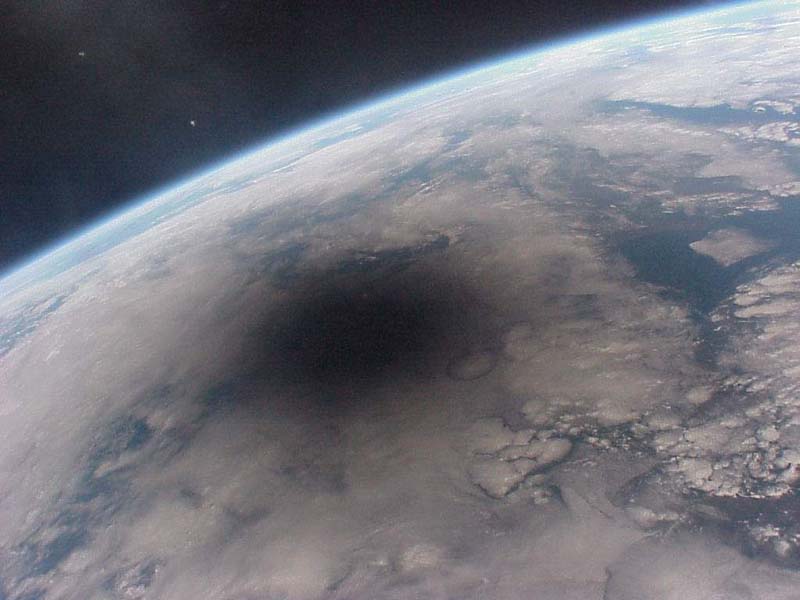
7. A total solar eclipse from space, 1999


(above) the shadow of the moon covers part of earth on august 11th, 1999 in this photo taken from mir space station. this shadow raced across earth at 2000 km/h, all areas under the centre of it plunged into darkness during a total solar eclipse. this was apparently one the final photos taken from mir.

8. Egmont National Park, New Zealand


(above) mt. egmont volcano last erupted in 1755 and is now situated at the centre of egmont national park. park regulations have ensured the survival of a forest which extends at a 9.5 km radius from the summit of the volcano, the result of which can be seen from space in the form of huge dark green disc. this photo was taken during the sts-110 mission, april 2002.

9. Mt. Etna eruption, October 2001


(above) taken from the international space station in 2001, this is a photo of a particularly violent eruption on the island of sicily which produced a cloud of ash that travelled as far as libya. on the humongous version of the photo lighter coloured smoke can be seen near the volcano - this was caused by lava igniting nearby forests.

10. Richat structure, Mauritania


(above) the cause of the richat structure in the sahara desert of mauritania has been debated for many years. at first it was thought to be a meteor impact crater due to its circularity but this has since been disproven due to the lack of shock-altered rock in its vicinity. this massive (30 mile diameter) oddity is now believed to have been a rock dome sculpted over time by erosion. this incredible image was taken by the advanced spaceborne thermal emission and reflection radiometer (aster) on october 7th, 2000.

The Impending Urban Millenium


In 2008, the world reaches an invisible but momentous milestone: For the first time in history, more than half its human population, 3.3 billion people, will be living in urban areas. By 2030, this is expected to swell to almost 5 billion. Many of the new urbanites will be poor. Their future, the future of cities in developing countries, the future of humanity itself, all depend very much on decisions made now in preparation for this growth.

While the world’s urban population grew very rapidly (from 220 million to 2.8 billion) over the 20th century, the next few decades will see an unprecedented scale of urban growth in the developing world. This will be particularly notable in Africa and Asia where the urban population will double between 2000 and 2030: That is, the accumulated urban growth of these two regions during the whole span of history will be duplicated in a single generation. By 2030, the towns and cities of the developing world will make up 81 per cent of urban humanity.

Urbanization—the increase in the urban share of total population—is inevitable, but it can also be positive. The current concentration of poverty, slum growth and social disruption in cities does paint a threatening picture: Yet no country in the industrial age has ever achieved significant economic growth without urbanization. Cities concentrate poverty, but they also represent the best hope of escaping it.

Cities also embody the environmental damage done by modern civilization; yet experts and policymakers increasingly recognize the potential value of cities to long-term sustainability. If cities create environmental problems, they also contain the solutions. The potential benefits of urbanization far outweigh the disadvantages: The challenge is in learning how to exploit its possibilities.

In 1994, the Programme of Action of the International Conference on Population and Development called on governments to “respond to the need of all citizens, including urban squatters, for personal safety, basic infrastructure and services, to eliminate health and social problems . . . .”(1) More recently, the United Nations Millennium Declaration drew attention to the growing significance of urban poverty, specifying, in Target 11, the modest ambition of achieving by 2020 “a significant improvement in the lives of at least 100 million slum dwellers”.(2)

UN-Habitat’s Third World Urban Forum, as well as its State of the World’s Cities 2006/7, successfully focused world interest on the deteriorating social and environmental conditions of urban localities.(3) The process of globalization has also drawn attention to the productive potential of cities and to the human cost. Yet the enormous scale and impact of future urbanization have not penetrated the public’s mind.

So far, attention has centred mostly on immediate concerns, problems such as how to accommodate the poor and improve living conditions; how to generate employment; how to reduce cities’ ecological footprint; how to improve governance; and how to administer increasingly complex urban systems.

These are all obviously important questions, but they shrink in comparison with the problems raised by the impending future growth of the urban population. Up to now, policymakers and civil society organizations have reacted to challenges as they arise. This is no longer enough. A pre-emptive approach is needed if urbanization in developing countries is to help solve social and environmental problems, rather than make them catastrophically worse.

The present Report thus attempts to look beyond current problems, real, urgent and poignant though they are. Yet, it is also a call to action. The Report tries to grasp the implications of the imminent doubling of the developing world’s urban population and discusses what needs to be done to prepare for this massive increase. It looks more closely at the demographic processes underlying urban growth in developing areas and their policy implications. It specifically examines the consequences of the urban transition for poverty reduction and sustainability.

It surveys the differing conditions and needs of poor urban women and men, and the obstacles they face as they strive to claim their rights and realize their potential as productive members of the new urban world.

Although mega-cities have received most of the attention, conditions in smaller urban areas call for even greater consideration. Contrary to general belief, the bulk of urban population growth is likely to be in smaller cities and towns, whose capabilities for planning and implementation can be exceedingly weak. Yet the worldwide process of decentralizing governmental powers is heaping greater responsibility on them. As the population of smaller cities increases, their thin managerial and planning capacities come under mounting stress. New ways will have to be found to equip them to plan ahead for expansion, to use their resources sustainably and to deliver essential services.

One of the Report’s key observations is that poor people will make up a large part of future urban growth. This simple fact has generally been overlooked, at great cost. Most urban growth now stems from natural increase (more births than deaths) rather than migration. But wherever it comes from, the growth of urban areas includes huge numbers of poor people. Ignoring this basic reality will make it impossible either to plan for inevitable and massive city growth or to use urban dynamics to help relieve poverty.

Once policymakers and civil society understand and accept the demographic and social composition of urban growth, some basic approaches and initiatives suggest themselves. These could have a huge impact on the fate of poor people and on the viability of the cities themselves. Throughout this Report the message is clear: Urban and national governments, together with civil society, and supported by international organizations, can take steps now that will make a huge difference for the social, economic and environmental living conditions of a majority of the world’s population.

Three policy initiatives stand out in this connection. First, preparing for an urban future requires, at a minimum, respecting the rights of the poor to the city. As Chapter 3 shows, many policymakers continue to try to prevent urban growth by discouraging rural-urban migration, with tactics such as evicting squatters and denying them services. These attempts to prevent migration are futile, counter-productive and, above all, wrong, a violation of people’s rights. If policymakers find urban growth rates too high, they have effective options which also respect human rights. Advances in social development, such as promoting gender equity and equality, making education universally available and meeting reproductive health needs, are important for their own sake. But they will also enable women to avoid unwanted fertility and reduce the main factor in the growth of urban populations—natural increase.

Secondly, cities need a longer-term and broader vision of the use of urban space to reduce poverty and promote sustainability. This includes an explicit concern with the land needs of the poor. For poor families, having an adequate piece of land—with access to water, sewage, power and transport—on which they can construct their homes and improve their lives is essential: Providing it requires a new and proactive approach. Planning for such spatial and infrastructure requirements, keeping in mind poor women’s multiple roles and needs, will greatly improve the welfare of poor families. This kind of people-centred development knits together the social fabric and encourages economic growth that includes the poor.

Similarly, protecting the environment and managing ecosystem services in future urban expansion requires purposeful management of space in advance of needs.

The “urban footprint” stretches far beyond city boundaries. Cities influence, and are affected by, broader environmental considerations. Proactive policies for sustainability will also be important in view of climate change and the considerable proportion of urban concentrations at or near sea level.

Thirdly, population institutions and specialists can and should play a key role in supporting community organizations, social movements, governments and the international community in improving the nature and form of future urban expansion, and thus enhancing its power to reduce poverty and promote environmental sustainability. A concerted international effort at this critical time is crucial to clarify policy options and provide information and analyses that will support strategies to improve our urban future.